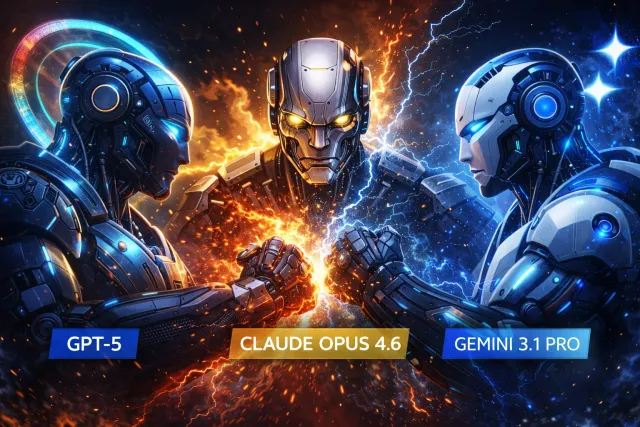
Claude Opus 4.5 Makes History: First AI Model to Break 80% on SWE-bench, Surpassing All Human Engineers

Anthropic's Claude Opus 4.5 achieves 80.9% accuracy on SWE-bench Verified software engineering benchmark, first to break 80% threshold, exceeding Google Gemini and OpenAI GPT-5, and outperforming all human engineering candidates in internal tests.

Claude Opus 4.5 AI model breakthrough performance

Anthropic’s Claude Opus 4.5, released on November 24, 2025, achieved a historic breakthrough in software engineering, becoming the first AI model to break the 80% accuracy threshold on the SWE-bench Verified benchmark with an impressive 80.9% score.

SWE-bench: The Ultimate Test of AI Software Engineering Capability

SWE-bench Verified is the industry’s most stringent software engineering AI evaluation benchmark, testing AI models’ ability to solve real-world programming problems.

This test includes programming bugs and feature requests extracted from real GitHub projects, requiring AI not only to understand problems but also to write actually functioning code fix solutions. Each test case is rigorously verified to ensure solutions genuinely work.

The 80% threshold has long been viewed as a critical indicator of AI reaching professional software engineer level. Claude Opus 4.5’s breakthrough signifies AI capabilities in programming have entered a new phase.

Surpassing All Competitors

Claude Opus 4.5’s 80.9% score significantly leads other top AI models:

  • Google Gemini 3 Pro: 76.2%
  • OpenAI GPT-5.1: 77.9%
  • Other mainstream models generally in 70-75% range

This 4.7 percentage point gap is quite significant in benchmark testing, representing Claude Opus 4.5’s clear advantage in handling complex programming tasks.

Outperforming Human Engineering Candidates

Even more shocking are Anthropic’s internal test results: Claude Opus 4.5 outperformed all human engineering candidates in the same engineering assessments.

This test simulated actual hiring processes, requiring candidates (including AI and humans) to solve a series of programming challenges. Results showed Claude Opus 4.5 not only far exceeded humans in speed but also reached or surpassed professional engineer levels in solution correctness and code quality.

This doesn’t mean AI will completely replace human engineers, but rather indicates AI can now serve as an extremely powerful programming assistant, handling repetitive, time-consuming coding tasks while letting human engineers focus on higher-level architecture design and innovation work.

Key Factors Behind the Technical Breakthrough

Claude Opus 4.5’s achievement of this breakthrough is attributed to several key technical improvements:

Larger context window: Ability to understand and process more extensive codebases, grasping overall project architecture.

Improved reasoning ability: Demonstrating deeper logical thinking and multi-step planning capabilities when solving problems.

Code understanding optimization: Significant improvements in understanding programming language syntax, design patterns, and best practices.

Error diagnosis precision: Ability to quickly locate problem root causes and propose accurate fix solutions.

Impact on Software Development Industry

Claude Opus 4.5’s breakthrough performance will have profound impacts on the software development industry:

Development Efficiency Boost

Engineers can delegate repetitive bug fixes, code refactoring, and unit test writing to AI, focusing on core feature development and system design. According to early user feedback, using Claude Opus 4.5 as a programming assistant can boost development efficiency by 30-50%.

Code Quality Improvement

AI can assist with comprehensive code reviews, discovering potential errors, security vulnerabilities, and performance issues, fixing them before they reach production environments.

Lowering Technical Barriers

For novice developers or non-technical personnel, Claude Opus 4.5 can provide real-time programming guidance and example code, accelerating learning curves.

Technical Debt Management

Legacy code refactoring and technical debt processing accumulated in many projects can be accelerated with AI assistance, making it easier for teams to maintain large codebases.

Intensifying AI Programming Tools Market Competition

Claude Opus 4.5’s breakthrough accelerates competition in the AI programming assistant market:

GitHub Copilot, backed by Microsoft and OpenAI, already has a massive user base.

Cursor and other editors focused on AI programming are rapidly rising, providing deeply integrated development experiences.

Tabnine, Amazon CodeWhisperer, and other vendors are also continuously improving their AI models.

Claude Opus 4.5’s entry will push the entire industry to raise standards, ultimately benefiting developer communities.

Practical Application Scenarios

Developers are already applying Claude Opus 4.5 in multiple scenarios:

Bug diagnosis and fixing: Quickly finding program issues and providing fix solutions.

Code refactoring: Improving existing code structure and readability without changing functionality.

API integration: Rapidly generating code for integrating with third-party services.

Unit test writing: Automatically generating test cases for functions and modules.

Documentation generation: Automatically producing clear documentation and comments for code.

Future Development Directions

Claude Opus 4.5’s SWE-bench breakthrough is just the beginning. Industry expectations are that AI programming capabilities will continue evolving:

  • Extending from single problem solving to complete feature module development
  • Deeper architecture design suggestions and technical decision support
  • Cross-project code migration and refactoring capabilities
  • Deep integration with CI/CD processes

However, experts remind that AI tools should be viewed as human capability enhancers, not replacements. Programming involves not just writing code, but also requirement understanding, user experience design, and business value judgment—areas still requiring human creativity and empathy.

How to Use Claude Opus 4.5

Developers can experience Claude Opus 4.5 through:

  • Direct use on the claude.ai website
  • Integration into development tools via Anthropic API
  • Using third-party IDE extensions supporting Claude

Claude Opus 4.5’s breakthrough performance proves AI has reached a new milestone in software engineering—not just technical progress, but a harbinger of fundamental workflow transformations in software development.

Sources:

作者:Drifter

·

更新:2025年12月8日 上午06:30

· 回報錯誤
Pull to refresh